|
Rules Tweaks
 Every
game has rules, and Dungeons and Dragons is no different. Over many years,
we find ourselves with the latest edition (DnD One or 2024), which has become fairly
popular after the widely derided 4th edition. There are always items that
need clarification, either because they are not clear, or because me and
my players find something that needs tweaking or even recreated. There are
also times when there are no rules for a subject, and creating a new one
is the way to solve the problem. Every
game has rules, and Dungeons and Dragons is no different. Over many years,
we find ourselves with the latest edition (DnD One or 2024), which has become fairly
popular after the widely derided 4th edition. There are always items that
need clarification, either because they are not clear, or because me and
my players find something that needs tweaking or even recreated. There are
also times when there are no rules for a subject, and creating a new one
is the way to solve the problem.
Below you will find information
about rules that I felt either needed adjusting or clarification, or need
to be created. If you find something that is incorrect as per what we've
already discussed, let me know. I usually will run changes through the
group first to ensure everyone is all warm and fuzzy.
Combat/Other
Armor Class and Dexterity
To add some realism to the game, there will be
situations when a PC or NPCs AC will not gain the benefit of dexterity.
Situations like this will be:
1. The character is swimming in water since they
have no "footing."
2. The character is incapacitated, paralyzed,
petrified, stunned, or unconscious.
***
Attack (defined)
In my game, an attack is any action against
someone that would be unwelcome by them. This includes spells that require
saves.
***
Attacking Through Allies
Melee
You cannot perform a melee attack through an
ally's square unless you have reach and the enemy is at least one size
larger than the creature impeding you.
Ranged (weapon & spell attack rolls)
When using a ranged weapon or spell attack through an
occupied square, the target on the other side will have 1/2 cover, which
gives the target +2 to AC. For a target that is two category sizes larger
or more than the impeding creature, there is no cover.
The above rules only apply when your ally is
within 5' of your intended target.
Those who have the Sharpshooter feat can ignore
the cover penalties as per the feat description.
***
D20 Critical Hits and Misses
If you roll a 1 on an attack roll, you miss,
regardless of pluses. If you roll a 20 on an attack roll, you hit no matter
how high the enemy's AC is.
***
Delay Turn
On your initiative, you may elect to delay your
turn and go when you announce your intention to do so. Once you go, you get
your action, bonus action, movement, and reaction as normal. Once you are
done, then you will wait until your next initiative roll to go.
You can delay your turn as long as you wish, even
into succeeding rounds. But when you take your turn, then you must wait
until your initiative on the next turn before you either go or delay again
on the next round's initiative. You may not perform actions then then delay
and then take movement, and so forth. All options must be taken when you
declare you're going.
If you cast a spell with a duration longer than
instantaneous, then countdown begins once you cast it and continues to do
so even if you delay your initiative. The ending of the spell will come in
the round at the time your initiative roll even if you delay past it. That
is why you still roll an initiative each round even if your intention is to
continue delaying.
For those with the Alert feat, you can swap with
someone on your rolled initiative and then you may delay your turn starting
at the new initiative you have swapped to.
***
Dropping an Item
If you drop an item in the same square in which
you occupy while there is an enemy or enemies adjacent to you, then you may
use an action to pick up the item without fear of penalties. This
represents you being mindful of attacks and dodging to avoid being hit.
If you proclaim that you are picking up the item as an object interaction,
which is free, then any enemy adjacent to you would have advantage on their
next attack as long as said attack is made against you first. So, they
cannot attack another enemy and then turn to hit you and get advantage.
They could, if they have multiple attacks, attack you first with advantage,
then use their second attack against whomever while only applying advantage
if they have an ability, flanking, spell effect, etc.
***
Flanking and Harrying
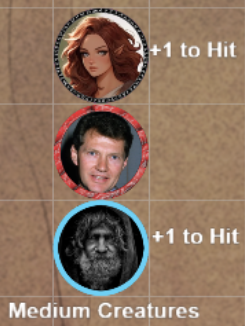
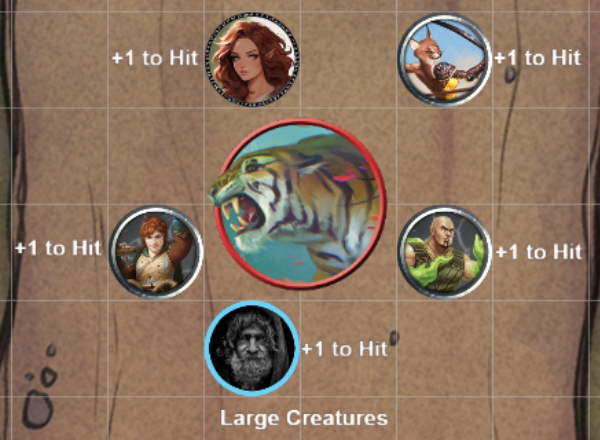
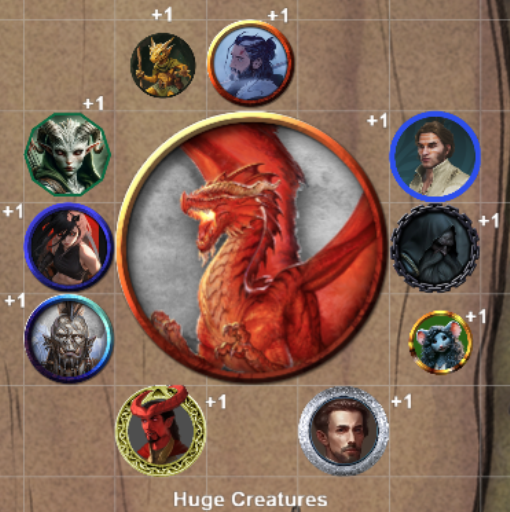
Harrying an opponent on a grid requires that you
meet two basic conditions: you must outnumber the foe, and you must be
combating the foe from more squares than it occupies. Therefore, it
requires two small or medium creatures to harry a medium foe, five small or
medium creatures to harry a large foe, and ten small or medium creatures to
harry a huge foe.
Once the numbers threshold is met, all attacking creatures receive a +1 to
hit, and an additional +1 when there are more attacking creatures (size
small or larger) than the required number. For example, if three medium
creatures surround a single medium foe, all three attackers would receive
+2 to hit. The maximum harrying bonus is +2. When attempting to harry a
creature that is adjacent to its ally, all adjacent foes must be harried
for any foe to be harried. It pays to fight side by side or back to back!
Physical cover can prevent harrying from a diagonal. Imagine your party is
in a room and opens a single door, revealing a tunnel behind that can
barely be seen around the frame of a bugbear that was sneaking up on you.
If combat commences in the three-foot-wide doorway, only the bugbear and
one party member can melee one another unhindered. Someone adjacent to the
one party member may be able to melee the bugbear with some difficulty
(cover from the doorframe), but would not achieve harrying from that
diagonal.
While advantage for flanking probably does a decent job of approximating
reality, it undercuts many character abilities that create advantage, and
it is not an option in the 2024 rules. There may be very rare circumstances
in which I indicate that your character can gain advantage by flanking.
However, any creature (this means your character as well) may use its
reaction to negate such an advantage. An attacker cannot benefit from both
flanking advantage and harrying. If a reaction has negated the flanking
advantage, the harrying bonus will occur if applicable.
Flanking and harrying are reliable tactics for gaining an edge on foes with
humanoid body types. Creatures with other body types, senses, and abilities
may be resistant or immune to these tactics. Consider whether a creature
relies on sight, whether its vision is forward-facing, whether its defenses
vary depending on its facing, whether it is corporeal, whether it is
flying, whether it even has a "front" and a "back."
***
Grappling
If someone is grappled by more than one creature,
they can only break one grapple per attack option.
Anyone grappled by three or more opponents is
restrained.
Also, size differential affects how easily a
target is grappled and how they break a grapple.
(moving a grappled creature) As per the rules, the
grappler can drag or carry you when it moves, but every foot of moment
costs it 1 extra foot unless you are tiny or two more size. Aside from the
size consideration, a grappler with a fly speed (if grappling in flight) or
a swim speed (if grappling while swimmingg) can move its full movement with a
creature if it is flying/swimming and the grappled creature does not have the
ability to fly/swim.
***
Jumping/Falling Down
You may jump
down up to 10' and would only need to make a DC 10 athletics check if you
are landing on difficult terrain. If you fail the DC, you take 1d6
bludgeoning and are prone. At 20' and above, the DC is mandatory. At 20',
the DC is 15, a miss is 2d6 bludgeoning, and you are prone; at 30', the DC
is 20, you take 3d6 bludgeoning, and you are prone. From 31' and
above, you automatically 3d6 bludgeoning damage, and you are prone. Max
falling damage is 20d6, and falling from 201' or more means your PC has
died.
***
Long Rest and
Sleep
There are
builds, invocation, spells, species, etc. that indicate a PC doesn't have
to sleep at all. I'm fine with this. But a PC still needs to spend at least
8 hours during every 24-hour period doing non-productive activities such as
resting, talking, reading, daydreaming, etc. Crafting, working on armor,
building something, any physical activity, is not allowed if you want to
gain the benefits of an 8-hour long rest.
***
Mounts
When a character is on a mount, that character is positioned in the exact
center of the space that the mount occupies, even if it means that
character is not positioned inside a square proper. A mount that is caught
in an area of effect sees its rider caught in the same area of effect. If
an attacker is within 5' of the edge of the mount's occupied space, then
the attacker can hit the rider of the mount with a 5' reach (or further)
unless that mount has special properties or the DM/character has a special
property or circumstance that takes the rider out of that 5' reach (or
further).
***
Movement
Creatures
When moving
through a square that is occupied, be it by a dead body, similar or another
creature, then that square becomes difficult terrain and costs double
movement to move through unless the occupying creature is two sizes smaller
than the one moving through.
Keep in mind
the following:
a: moving
through an ally's square imposes the movement penalty for difficult terrain
UNLESS the ally whose square you're moving through used THEIR reaction to
allow you to pass. The ally using their reaction must have at least a 6
intelligence or be too dumb to think of such actions.
b: moving
trough the square of someone who does not wish for you to pass, such as an
enemy, is not possible.
c: moving
through a square with one body (dead, incapacitated, paralyzed, etc.),
where the occupying creature cannot oppose you, is possible, but will be
difficult terrain. If there are two bodies in a square, unless they are
tiny, you cannot move through the square unless you jump over it or move
the body(s) so there is only one in your way.
Mounting/Dismounting/Standing From Prone
This only
takes 1/2 of a creature's unmodified base movement. So, for example, a 5th
level monk who has +15' of movement for a total of 45', would only use 15'
(1/2 of their base 30' of movement). The same formula applies to a creature
that is hasted and so forth.
Flying Magic
Item Movement
Since magic
items have no actions, they do not get to dash. Therefore, they cannot move
more than their described movement total. Magic items, spells, and potions
that are designed to enhance the movement of a creature, such as a potion
of flying, or ring of haste, do are not constrained by the above
definition.
***
Movement
Through Occupied Squares
In the new
rules, you may move unhindered through the square of an ally, a creature
that is incapacitated, a tiny creature, or a creature that is two sizes
smaller than you.
In my world,
any space occupied by a creature that is small or larger will be considered
difficult terrain, which costs double movement to move through. If the
creature occupying the square is an ally, you may move though the square at
double the movement cost. If the ally is tiny or two sizes smaller than
you, then you may move through the square normally. If the creature is an
enemy, you many not move through the square unless the creature is tiny or
two sizes smaller than you.
If there are
two or more creatures in a square (meaning they're usually dead or prone),
you may jump over the square using the horizontal jump rules, or you can
crawl through the square at double the movement cost. When you get through
the square to an unoccupied space, you will be prone and must spend at
least half your base movement to stand up.
Also, the
rules say that if two creatures somehow end up in the same space
unwillingly, they will both be prone. What I will not allow is for a
creature to purposefully shove a creature into the space of another with
the intent of knocking them prone. This is a way of gaming the system. If a
creature is shoved into the the space of another creature and ends their
turn there, then the two creatures in the square will roll opposing grapple
checks (athletics or acrobatics). The loser will be pushed five feet away
into the nearest random open square.
***
Opportunity
Attacks
1. In the new
rules, when a creature you can see leaves your reach, you can use one
reaction per round to make one melee attack with a weapon or unarmed strike against
that creature. The attack occurs right before it leaves your reach.
2. In some instances, a creature can avoid an
opportunity attack from an enemy within melee range. This can be done via
spells, class features, feats, magic item functionality, or something
similar that allows them to do so. Examples include, but are not limited
to: cunning action, misty step, teleport, and a creature that has a
specified ability that allows them to avoid opportunity attacks.
3. In the case where a creature is moved by
someone else, such as by telekinesis or simply being grabbed, pushed,
dragged, or otherwise, they are still subject to being attacked unless rule
2 applies.
4. Someone with the incapacitated, paralyzed,
unconscious, or dead condition would still be subject to an attack of
opportunity if they are moved out of an enemy's melee threat range. Keep in
mind that an enemy choosing to take the opportunity attack would usually
only do so under certain rare instances, such as wanting to finish off a
hated foe, wishing to make sure the dangerous foe isn't healed to be a
problem later, or for some other tactically sound reason.
5. You may physically pick up a creature with the
incapacitated, paralyzed, unconscious, or dead condition and move them from
an adjacent enemy without an attack of opportunity if you are using the
disengage action, a magical effect that instantly takes you and the person
you are carrying away instantly (such as misty step or teleport), or a
class feature or other that allows you to avoid an attack of opportunity.
***
Water
Combat
If you
are swimming in the water, and you don't have any special abilities that
allow you to move unhindered by the water, you may attack using any means
at your disposal. The order goes like this:
1. On your
action, make a DC 10 athletics check (+1 for every 50 lbs. of gear
you're carrying).
If you fail,
you're done because you're too busy flopping around trying to keep from
drowning to do anything else (unless you have some method of breathing
underwater, such as a potion of water breathing and/or possess some other
means of propulsion giving you swim speed). In that case, you'd be able to
breathe but would still be fighting to tread water or sink.
If you
succeed, attack as normal.
Top of
Page
Feats/Skills
Arcana Checks
As the PH:
"Your Intelligence (Arcana) check measures your ability to recall lore
about spells, magic items, eldritch symbols, magical traditions, the
planes of existence, and the inhabitants of those planes."
If you see a spell being cast by
someone, you can use an Arcana check to determine what that spell is if it
is a spell that can be cast by you. If you can't, then you can only know
that a spell is being cast. If you can cast that spell because you are of
the appropriate class and level, the DM will have you roll the check based
upon the DC that he has determined. If you make the roll, then you know
what the spell is.
As for using an Arcana check to
determine what spell a person is under the influence of after the spell
has already been cast, you can determine symptoms that point to a spell
type, such as charmed or diseased or something that debilitates the body,
etc. So, for example, you believe your friend is under the effects of a
spell because he's attacking the party. You make a successful Arcana check
to know that a spell is in play and that the general effect is charm. You
can then make an investigation check to connect what you see with a
specific spell that you have knowledge. This can only be done if you are
able to cast the spell that was used due to class and level.
***
Feat (Sharpshooter)
Prerequisites: 4th level; Dexterity 13 or
higher)
You gain the following benefits.
Ability Score Increase. Increase your Dexterity
score by 1, to a maximum of 20.
Bypass Cover. Your ranged attacks with weapons ignore Half Cover and
Three-Quarters Cover.
Firing in Melee. Being within 5 feet of an enemy doesn’t impose
Disadvantage on your attack rolls with Ranged weapons.
Long Shots. Attacking at long range doesn’t impose Disadvantage on your
attack rolls with Ranged weapons.
Precision Shots. When you hit a creature with a ranged weapon that has the
Two-handed property as part of the Attack action on your turn, you can
cause the weapon to deal extra damage to the target. The extra damage
equals your Proficiency Bonus.
Top of
Page
Magic
Items
Purchasing/Commissioning Magic Items/Potions
Availability
of Common and Uncommon Items for Sale
This is based
on factors such as the item's rarity, the overall rarity of magic in the
area, political doctrine, and other considerations. See explanations below.
A city's population size is essential to calculating item availability.
Common and uncommon magic items are usually available in magic shops, with
the number limited by population size. Rare and Very Rare items are never
in shops waiting to be sold, as they are too expensive to make just to put
on a shelf and wait to be bought. Such valuable items are found through
individual sellers or by commissioning crafters (see the "Rare and Very
Rare Crafting" section below).
|
Rarity |
Population |
Shops |
Magic Items Per Shop |
Potions Per Shop |
|
Common |
100-200 |
1 |
n/a |
2d4+1 |
|
Common |
201-500 |
1 |
1d4+4 com |
2d4+2 |
|
Common |
501-1000 |
2 |
2d4+2 com |
2d4+4 |
|
Com/Unc |
1001-2000 |
2 |
2d4+3 com/1d3+1 unc |
3d8+2 com/1d4+2 unc |
|
Com/Unc |
2001-3000 |
3 |
2d4+4 com/1d3+2 unc |
3d8+4 com/1d4+3 unc |
|
Com/Unc |
3001-4000 |
3 |
3d4+3 com/2d4+1 unc |
4d8+2 com/2d4+2 unc |
|
Com/Unc |
4001-6000 |
3 |
3d4+4 com/2d4+2 unc |
4d8+4 com/2d4+3 unc |
|
Com/Unc |
6001-8000 |
4 |
4d4+3 com/2d4+4 unc |
5d8+2 com/3d4+2 unc |
|
Com/Unc |
8001-11000 |
4 |
4d6+4 com/3d6+2 unc |
5d8+4 com/3d4+3 unc |
|
Com/Unc |
11001-14000 |
5 |
4d6+6 com/3d6+4 unc |
6d8+2 com/4d4+2 unc |
|
Com/Unc |
14001-17000 |
5 |
5d6+4 com/4d6+2 unc |
6d8+4 com/4d4+3 unc |
|
Com/Unc |
17001+ |
6 |
5d6+6 com/4d6+4 unc |
7d6+2 com/5d4+2 unc |
Note: The numbers under the "Items Per Shop"
and "Potions Per Shop" columns represent random products to be rolled for
each available shop.
Crafter Availability Per Community
Those within a community who are skilled and of
the level to craft items is important, as it dictates the max item rarity.
Also, the number of crafters is important in calculating item crafting
time. For example, a +1 shield, which is uncommon, would have a base line
of 10 days to craft. But if you go into a small community with only 3
crafters available, there is a good chance they all have things on their
plate and might not be able begin crafting for days or even weeks.
The table below will give display populations and
how many crafters live there. The DM will determine how many, if any, are
available and how much time it would take to get to the crafting and the
crafting itself, as well as cost based upon rarity, demand, and other.
Crafters will be wizards and clerics, and their max level for the listed
population will be on the table below.
There may be individual crafters living in a
community that are of a level that is above that listed in the table. They
can be found by doing things like: posting on a community bulletin board,
asking around town, greasing the palms of people who are adept at finding
people, such a those working in a thieves guild. The risks of doing this
are inherent.
NOTE: There may be situations where there are more
or less clerics/wizards in a community than are listed on the table below.
The DM will advise at the time.
| Population |
# of Clerics |
Max Level |
# of Wizards |
Max Level |
| 100-200 |
1 |
3rd |
1 |
2nd |
| 201-500 |
2 |
4th |
2 |
4th |
| 501-1000 |
4 |
6th |
3 |
5th |
| 1001-2000 |
8 |
6th |
4 |
6th |
| 2001-3000 |
12 |
8th |
6 |
7th |
| 3001-4000 |
16 |
8th |
8 |
7th |
| 4001-6000 |
18 |
10th |
10 |
8th |
| 6001-8000 |
20 |
12th |
12 |
10th |
| 8001-11000 |
24 |
14th |
13 |
12th |
| 11001-14000 |
28 |
16th |
15 |
15th |
| 14001-17000 |
32 |
18th |
17 |
17th |
| 17001+ |
40 |
20th+ |
20 |
20th+ |
Rare and Very Rare Crafting
Leaders are wary of anyone commissioning powerful
magic items (rare and very rare) in their communities, which have strict
laws regarding the reporting of such activities. Resident crafters who fail
to do so risk heavy fines and imprisonment. Anyone wishing to commission a
local craftsman to craft rare or very rare items must go to the local
wizard’s guild (or related governmental body) to be identified, their
reasons for requesting the item known, and taxed (typically 10% of the
item's creation cost).
Legendary Item Crafting
Due to the extreme power of these magic items, permission of a Duke or
Higher must be gained, which is very rare unless the circumstances are
extreme. The tax rate for such an item will be no less than 25% of its cost
of creation.
Rare and Very Rare Items for Sale
It is possible someone in a city privately owns an item for sale, or
perhaps some items are available through underground channels. To find
them, you must contact the “right” people, such as wizards and thieves.
Wizards in a guild usually follow strict rules and will not circumvent laws
by purchasing underground merchandise unless there are well-induced.
Thieves in a guild are typically willing to put feelers out for a hefty
fee, with no promise of finding the item you are looking for, not to
mention there is always the question of their trustworthiness.
The higher the item’s rarity, the less likely it is to be available, and
the higher the cost.
Legendary Items for Sale
Any that exist are jealously owned/guarded and not for sale under any
circumstances.
A Note on Payment for Services
Not all crafters are keen on accepting hard
currency for their time. Many will require the person(s) requesting
services to acquire something of value the crafter needs. This may involve
a quest or something similar, so be prepared.
***
PC Crafting Information
Crafting Boundaries
In my game,
the story is the focus, not pumping out magic items and diluting the wonder
and coolness that comes with finding a magic item in a loot pile. With that
said, adventurers who are spending their time questing (for the most part)
can only craft potions and magic items of uncommon or lower. Anything higher than uncommon
must be crafted in a brick and mortar
environment.
***
Crafting Magic Items and Potions of Healing
Magic Items
Potions Poisons
Spell Scrolls
Magic Items
Crafting Time and Cost
The table
below represents the rarity, time, and cost associated with creating magic
items and non-healing potions (there is a separate section below for that).
For the purchase price of a completed item, which is based upon their
rarity, simply double the listed cost. Other factors that can affect
purchase prices include, but are not limited to, region, political
atmosphere, rarity of magic items overall, private seller vs. business,
etc.
NOTE: The
crafting and purchase prices apply to potions that are NOT healing, which
have their own rules regarding creation, prices for crafting, and
purchasing outright. See the "Healing Potions" section below. The table
below represents the Rarity, Time, and Cost for crafting magic items. For
purchasing them outright, just double the listed cost.
Also, listed
prices for crafting and the implied sales price (double that of crafting)
are NOT static. In other words, the prices can fluctuate based upon current
environments/situations such as demand, available crafters, and others. The
DM will give prices at the time and place of the commission.
| Rarity |
Time* |
Cost* |
**Level |
| Common |
5 days |
50 gp |
3< |
| Uncommon |
10 days |
200 gp |
6< |
| Rare |
30 days |
2,000 gp |
10< |
| Very Rare |
90 days |
20,000 gp |
14< |
| Legendary |
180 days |
100,00 gp |
18< |
*Halve the
value for a consumable item other than a Spell Scroll. The value of a Spell
Scroll is double what it costs to scribe the scroll (as specified in the
Player's Handbook).
**The
level you must be to create an item of this rarity.
The table
below shows what tools are needed to craft magic items.
| Item Category |
Required Tool |
| Armor |
Leatherworker's Tools, or
Weaver's Tools depending on the kind of armor as noted in the tools'
descriptions |
| Potion* |
Alchemist's Supplies or
Herbalism Kit |
| Ring |
Jeweler's Tools |
| Rod |
Woodcarver's Tools |
| Scroll |
Calligrapher's Supplies |
| Staff |
Woodcarver's Tools |
| Wand |
Woodcarver's Tools |
| Weapon |
Leatherworking Tools,
Smith's Tools, or Woodcarver's Tools depending on the kind of weapon
as noted in the tools' descriptions |
| Wondrous Item |
Tinker's Tools or the tool
required to make the nonmagical item on wich the magic item is based |
Spells.
If a magic item allows its user to cast any spells from it, you must have
all those spells prepared every day you spend crafting the item.
Work per
Day. For each day of crafting, you must work for 8 hours and must be
worked on in a stationary location, not a moving wagon or other vehicle.
Assistants. Characters can combine their efforts to shorten the
crafting time. Divide the time needed to create an item by the number of
characters working on it. For Irith, no more than two can work on crafting
an item.
Raw
Materials. The cost in the table represents the raw materials needed to
make a magic item. The DM determines whether raw materials are available.
In a city, there is a 75 percent chance that the materials are available,
and in any other settlement, that chance is 25 percent. If materials aren't
available, you must wait at least 7 days before checking in the same
city/settlement again.
If a magic
item incorporates an item that has a purchase cost (such as a weapon or a
suit of armor), you must also pay that entire cost or craft that item using
the rules in the Player's Handbook. For example, to make +1 Armor (plate
armor), you must pay 3,500 gp or pay 2,000 gp and craft the armor.
Top of Crafting Section
Potion
(healing only) Crafting Cost, Time, and Purchase Prices
Brewing
Potions of Healing. Potions of healing fall into a special category for
item crafting, separate from other magic items. A character who has
proficiency with the herbalism kit can create these potions. The times and
costs for doing so are summarized on the table below.
| Type |
Time |
Cost |
*Level |
| Healing |
8 hours |
25 gp |
2< |
| Greater Healing |
24 hours |
100 gp |
4< |
| Superior Healing |
72 hours |
800 gp |
7< |
| Supreme Healing |
160 hours |
2,500 gp |
11< |
The time
for brewing these potions is not halved like non-healing potions listed in
the crafting table for magic items above. This is due to them not being
magical items despite their magical effects.
*The level
you must be to create this rarity of potion.
Top of Crafting Section
Poison
Crafting Cost, Time, and Purchase Prices
Anyone
wishing to craft poisons must be proficient in the poisoner's
kit. The amount of time to craft a potion is 1 hour per 100 gp sale value
of the poison. The cost is half the listed sale price. This is based upon
the prices of the available potions listed on page 90 of the 2024 DMG. See
the table listed below for easy reference.
The minimum
level of the crafter is listed on the table below and represents the
experience necessary to craft a potion based upon it's sale price.
Harvested
poison from creatures will be on a case-by-case basis. If information on
the process/damage/saves/whatever isn't listed in the harvesting guide. I
will work with you on what the poison does and so forth.
Keep in
mind that coating one weapon or up to three pieces of ammunition is a bonus
action. Once applied, the poison remains active for 1 minute or until its
damage is dealt, whichever comes first.
Top of Crafting Section
Spell Scrolls
Time and Cost
A spell
scroll is a scroll that can be read to trigger the spell inscribed upon it.
A scroll that simply has the instructions on how to cast a spell, which can
then be copied into a spellbook, is different. Look for the section below
called "Copied Spells in Scrolls."
Scribing a
spell scroll takes an amount of time and money based on the level of the
spell, as shown in the Spell Scroll Costs table below. For each day of
inscription, you must work for 8 hours. If a scroll requires multiple days,
those days needn't be consecutive. The scroll can only be worked on in a
stationary location, not a moving vehicle.
Prerequisites for the Scribe
To scribe a
scroll, you must have proficiency in the Arcana skill or with
Calligrapher's Supplies and have the spell prepared on each day of the
inscription. You must also have at hand any material components required by
the spell; if the spell consumes its Material components, they are consumed
only when you complete the scroll. The scroll's spell uses your save DC and
spell attack bonus.
If the
scribed spell is a cantrip, the version on the scroll works as if the
caster were your level.
The table
below lists the crafting prices, meaning that the purchase price will be
double what is listed. The table below has the Save DC and Attack Bonus of
scrolls that you find for sale.
| Spell Level |
Save DC |
Att. Bonus |
Rarity |
Time |
Cost |
| Cantrip |
13 |
+5 |
Common |
1 day |
15 gp |
| 1 |
13 |
+5 |
Common |
1 day |
25 gp |
| 2 |
13 |
+5 |
Uncommon |
3 days |
100 gp |
| 3 |
15 |
+7 |
Uncommon |
5 days |
150 gp |
| 4 |
15 |
+7 |
Rare |
10 days |
1,000 gp |
| 5 |
17 |
+9 |
Rare |
25 days |
1,500 gp |
| 6 |
17 |
+9 |
Very Rare |
40 days |
10,000 gp |
| 7 |
18 |
+10 |
Very Rare |
50 days |
12,500 gp |
| 8 |
18 |
+10 |
Very Rare |
60 days |
15,000 gp |
| 9 |
19 |
+11 |
Legendary |
120 days |
50,000 gp |
Copied Spells
in Scrolls
Scrolls that
have spells copied into them as a record or to be copied into another
spellbook cannot be cast and activated from the scroll like a Spell Scroll.
To make one, the person must have a spell to copy it from, proficiency in
the Arcana Skill, and Calligrapher's Tools. For each level of the spell
(with a cantrip equaling a 1st level spell) he transcription cost is 50 gp
and takes 2 hours.
Top of Crafting Section
***
Identifying
Magic Items
In my world,
there are only 3 ways you can know the abilities of a magic item and how to
use it: someone who already knows how to use the item instructs you,
identifying the item with a spell such as identify, or you use trial and
error. I want there to be a little effort in finding out what cool item you
have rather than just "playing with it" and knowing all its secrets.
Potions
Only the
following methods can be used to identify a potion:
1. Pay an Alchemist to identify it for you.
2. Use an Identify spell.
3. If your character has an alchemist background
or has the ability to cast arcane spells, then I will allow you to use make
a DC check to identify the potion.
4. Take a taste and the DM will give you a little
inkling about how you feel. At that point, the character can make an Arcana
check to determine the potion's properties (i.e. if it's a fly spell, the
successful check means the character knows that the potion will allow them
to fly but not duration and speed and so forth). Detailed information (by
tasting only) can only be determined by a successful Arcana check by a
spell caster who can cast the spell that potion effect emulates.
*NOTE* If you've consumed a potion before and know
what the effects are, then going forward, you will be able to take a little
taste and identify the spell right away.
***
Polymorph (the spell)
The beast that the target is polymorphed into
shall have full HP up to but not exceeding the HP total of the target
creature. This means that if, for example, Bob the fighter has 70 hp after
a long rest, and Mary turns him into a great ape, the great ape, which
usually has over 160 hp, would only have 70 temp hp. On the other hand, if
Bob is changed into a rat, he would have the max temp hp that a rat has
because it is under Bob's max of 70.
This avoids turning someone into a creature with
much more HP than they would normally have.
***
Sanctuary (the spell)
The 2024 Sanctuary was a little nerfy so I changed
made the following change:
Old 2024 sanctuary spell excerpt:
"The spell ends if the warded creature makes an
attack roll, casts a spell, or deals damage."
Irith Homebrew sanctuary change (the rest of
the spell stays the same): "The spell ends if
the warded creature makes an attack roll, casts a spell, or deals damage ON
SOMEONE OTHER THAN THEMSELVES. ALSO, IF AN ENEMY IS DAMAGED BY SOMETHING ON
THE WARDED TARGET'S PERSON, SUCH AS EMANATIONS FROM A SPELL OR MAGIC ITEM
OR CLASS FEATURE, ETC. THE WARD ENDS FOR THE WARDED TARGET."
***
Spell Casting Cost Per Level (Hirelings)
The amount of money you pay for a spell to be cast
by a hireling, such as a cleric or wizard, will be based upon the following
formula (Level)2 x 10 + (Consumed Materials x 2) + (Non-consumed Materials
x 0.1). This formula is based upon DnD Adventure rules and seems quite fair
to me. The table below will show all spells levels and BASE cost before
factoring in the consumed/non-consumed materials modifiers.
| Spell Level |
Base Cost |
| Cantrip |
5 gp |
| 1st |
10 gp |
| 2nd |
40 gp |
| 3rd |
90 gp |
| 4th |
160 gp |
| 5th |
250 gp |
| 6th |
360 gp |
| 7th |
490 gp |
| 8th |
640 gp |
| 9th |
810 gp |
Top of
Page
Spells
This section
is for information regarding what I allow, tweaks of current spells, and
perhaps a homebrew spell or two.
Forbidden
Spells
Silvery Barbs
and Vortex Warp.
***
Here are changes/additions to existing spells.
Reincarnate
I have updated the list of possible reincarnated
humanoids to include more races, including homebrews. See the list below:
1. Aasimar
2. Centaur
3. Draconian (roll d8 to determine what Draconian type)
Black
Blue
Brass
Bronze
Copper
Gold
Green
Red
Silver
White
3. Dracothel (Kobold)
4. Dwarf (roll d2 to determine Dwarf type)
Normal
Barethkor (Duergar)
5. Elf (roll d4 to determine Elf type)
High
Shenuri (Dark Elf)
Thriiche (Ice Elf)
Wood
6. Gnome (roll d3 to determine Gnome type)
Forest
Rock
Torozen (Svirfneblin or Deep Gnome)
7. Goliath (roll d6 to determine what Goliath type)
Cloud
Fire
Frost
Hill
Stone
Storm
8. Halfling
9. Human
10. Kryth
11. Ratkin
12. Sethraak
13. Tabaxi
14. Tiefling
**
***
This section is for new spells.
Wither
4th-level necromancy
Casting Time: 1 action
Range: 150 feet
Components: V, S
Duration Instantaneous
This spell harms plant life, including plant creatures. You can choose one
of two options below in how the spell is applied. Also, there are no
long-term effects on the land itself in the spell radius.
Normal Plants. You choose a point within range. All normal plants
in a 100-foot-radius sphere centered on that point wither, die, and become
blackened ash. This effectively eliminates plant growth that causes
difficult terrain. Note, this spell does not work against the Spike Growth
or Wall of Thorns spells.
Plant Creatures. A plant creature you can see within range makes a
Constitution saving throw, taking 4d8 Necrotic damage on a failed saving
throw or half as much damage on a successful one.
Using a Higher-Level Spell Slot. The damage against a plant
creature increases 1d8 for each spell slot level above 4.
Classes: Druid, Sorcerer, Warlock, Wizard
Top of
Page
|